
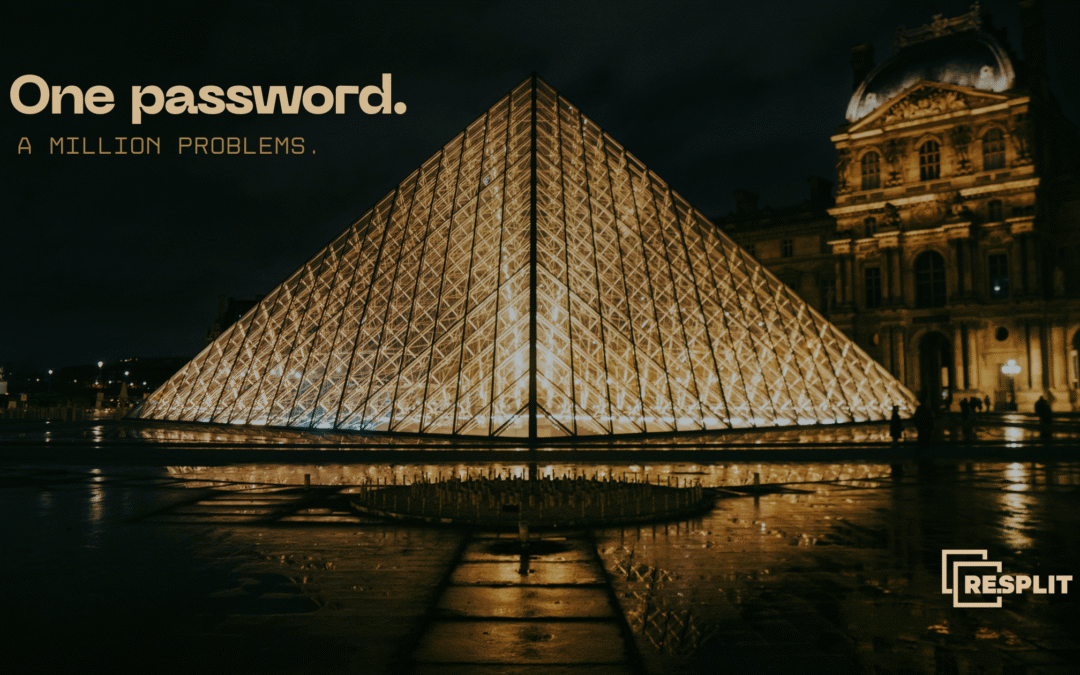
Password security 2025 is at the core of this story and the Louvre incident is the most striking reminder of how basics still decide outcomes. In October 2025, the Louvre faced one of the most surreal and expensive security failures in modern history, still the real issue went far beyond the physical heist. A group of thieves stole priceless royal jewels, but the real shock wasn’t the heist itself.
In fact, the real shock came from the discovery that part of the museum’s CCTV system was protected with a single, painfully simple password:
“Louvre”.
It was one word with no numbers, no symbols and no additional security layers.
In 2025, the era of AI-driven threat detection, biometrics and Zero Trust architectures, the world’s most famous museum lost millions because someone didn’t bother to change a default password.
And that’s the lesson:
even the most advanced systems collapse when the basics are ignored.
Furthermore, this isn’t just a museum’s problem. It’s a problem for every company building software, storing client data, deploying cloud services and running internal tools.
What technically went wrong (and why it matters)
Cybersecurity analysts highlighted several issues behind the scenes:
- a critical segment of the CCTV system used a trivial, guessable password
- outdated firmware and postponed security patches
- lack of proper access segmentation
- absence of MFA on administrative accounts
- disconnected physical and digital security procedures
- no active monitoring for unusual login patterns
In short:
the attack didn’t require sophisticated hacking. The door was already open.
This is what security experts call a low-hanging fruit attack.
Back in our earlier article, we explained the basics of strong passwords and this Louvre incident shows why those fundamentals still matter in password security 2025.
Why password security 2025 matters for software companies
Because modern software development environments are more complex and more exposed than ever.
We rely on:
- cloud infrastructure
- remote access
- APIs and integrations
- internal dashboards
- CI/CD pipelines
- microservices
- IoT devices
- development vs production environments
Therefore, every one of these is a potential entry point.
In reality, most cyber incidents don’t start with genius-level hacking; they start with weak passwords, leaked tokens and shared admin accounts.
In fact, the Louvre incident is just a high-profile reminder.
What MFA actually is (and why you need it everywhere)
MFA (Multi-Factor Authentication) means verifying identity using two or more of the following:
- Something you know
Password, PIN - Something you have
Phone, security key, code-generating app - Something you are
Biometric authentication (fingerprint, face, iris)
A typical MFA login:
- you enter your password
- your phone generates a one-time 6-digit code
- you approve the login
Even if someone guesses or steals your password, MFA blocks the intruder.
If MFA had been active at the Louvre:
- login attempts would have triggered alerts
- attackers wouldn’t have been able to disable the cameras
- unauthorized access would have been denied instantly
It wouldn’t stop the physical heist, but it would stop the digital parts that made it possible.
Password security 2025: the non-negotiable minimum
Here’s the bare minimum for organizations in 2025:
- Unique passwords for every system
Therefore, using one password everywhere turns a single leak into a full compromise. - A company-wide password manager
Bitwarden, 1Password, Dashlane… Pick one, enforce it. For example, a shared password manager reduces weak or reused passwords across the team. - Regular rotation for critical accounts
Admin and service accounts should rotate at least twice a year. - Role-Based Access Control (RBAC)
Not everyone needs admin.
Not everyone needs production access.
Not everyone needs everything.
Moreover, RBAC prevents privilege creep and limits the blast radius of a compromised account. - Zero Trust as a philosophy
Don’t assume anything is safe.
Every identity, device and request must be verified.
In other words, Zero Trust treats every access request as potentially risky. - Segment internal access
If one compromised account can reach all systems, that’s not a setup. That’s a liability.
As a result, segmentation isolates incidents before they spread.
How password security 2025 affects modern software development
Software development teams work with:
- git repositories
- deploy keys
- API tokens
- CI/CD secrets
- staging/production databases
- cloud access credentials
- internal dev tools
And the most common security failures happen because:
- passwords or tokens leak into public repos
- default admin accounts are never changed
- MFA is disabled “because it’s annoying”
- production and staging share the same credentials
- Wi-Fi networks aren’t segmented
- shared accounts are used “just for convenience”
In other words:
if the world’s biggest museum can fall because of a weak password, so can any software team that treats security as an afterthought.
How to protect your organization (without slowing down your team)
- Enable MFA everywhere
E-mail, dashboards, servers, cloud, repos… Everywhere.
As a result, MFA adds an essential layer of protection even when passwords fail. - Segment access by roles
Developers don’t need access to accounting.
Admins don’t always need access to production.
Limit everything by necessity. - Harden your systems
disable default ports
limit login attempts
implement firewalls and IDS/IPS
separate production from staging - Security audits and pentests
At least once per year. More if handling sensitive data. - Conduct regular access reviews
Every offboarded employee should lose access the same day.
Not “next week”. - Mandatory password manager for the whole team
One tool. One policy. No excuses.
The Louvre gave us a warning. We should listen
The 2025 Louvre password incident is more than a bizarre headline.
It’s proof that:
- security failures often start with the simplest oversight
- MFA is no longer optional
- password hygiene is still the foundation of protection
- Zero Trust isn’t a trend, it’s survival
- password security 2025 is a business-critical priority
As a result, between a protected system and a multimillion-euro disaster, sometimes the only difference is one single password.
One.
Single.
Password.
So make sure yours isn’t “Louvre”.
In addition, for more insights on software, cybersecurity and digital best practices, explore other articles on our blog.